The best road cycling routes around La Fontenelle
4.3
(8)
268
riders
81
rides
Road cycling around La Fontenelle, located in the Bretagne region of France, offers routes characterized by rolling hills and rural landscapes. The area features a network of quiet country roads passing through agricultural land and small villages. Cyclists can expect varied terrain with moderate elevation changes, providing both scenic rides and opportunities for sustained efforts.
Best road cycling routes around La Fontenelle
- The most popular road cycling route is Souday et Montmirail — loop from Saint-Agil — Parc naturel de…
Last updated: July 4, 2026
2
riders
47.1km
02:08
390m
400m
Moderate road ride. Good fitness required. Mostly well-paved surfaces and easy to ride.
7
riders
82.3km
03:40
750m
750m
Moderate road ride. Good fitness required. Mostly well-paved surfaces and easy to ride.

Sign up for free
5
riders
64.7km
02:41
340m
340m
Moderate road ride. Good fitness required. Mostly well-paved surfaces and easy to ride.
4
riders
55.5km
02:34
390m
390m
Moderate road ride. Good fitness required. Mostly well-paved surfaces and easy to ride.
3
riders
49.9km
02:08
310m
310m
Moderate road ride. Good fitness required. Mostly well-paved surfaces and easy to ride.
Get access to more routes and recommendations from other explorers.
Sign up for free
Already have an account?
Our route recommendations are based on thousands of hikes, rides, and runs completed by other people on komoot.
Start today with a free account
Your next adventure awaits.
Login or Signup



Tips from the Community

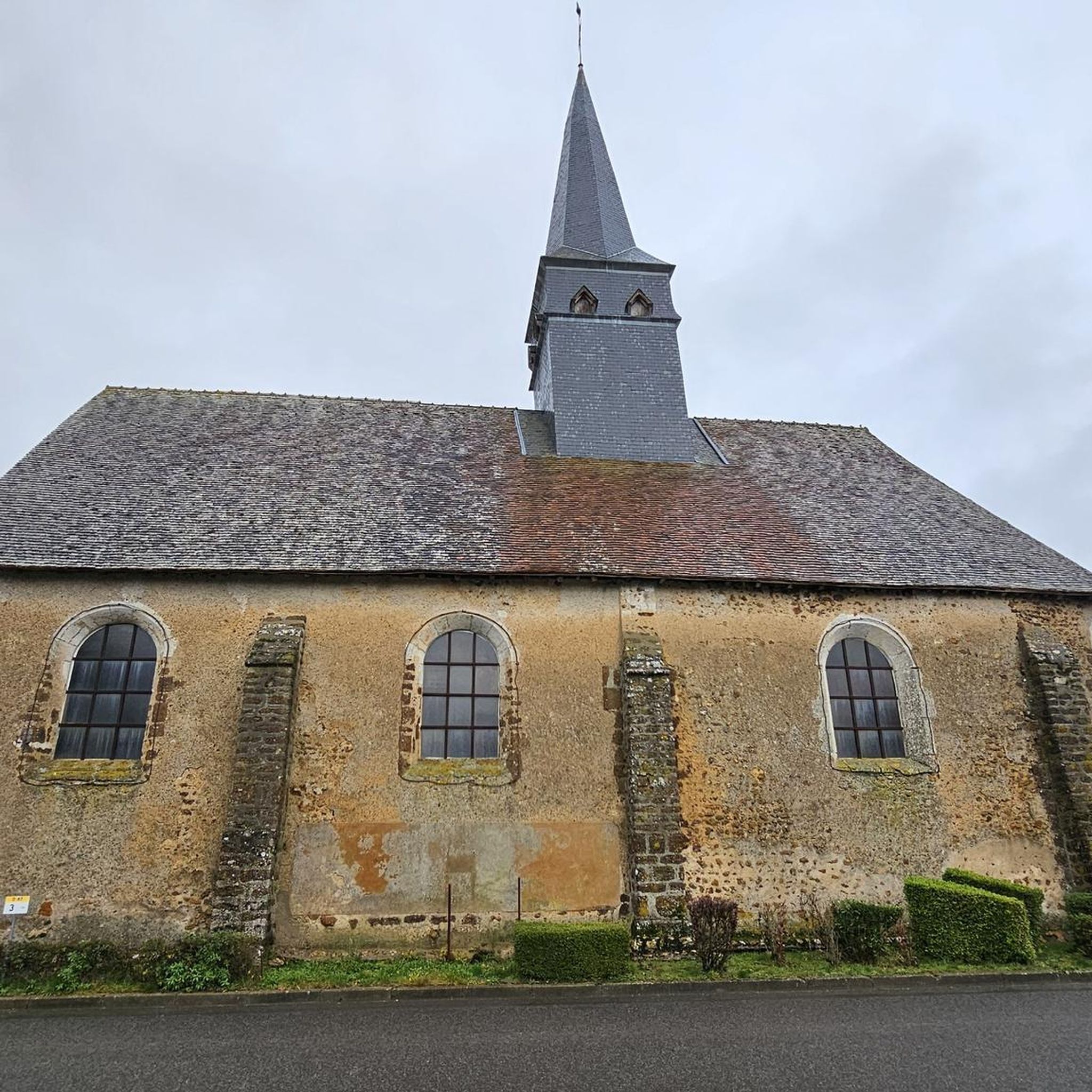
Placed under the patronage of Saint Hilaire, this parish was given by Gannelon de Montigny, lord of the place, to the abbey of Marmoutier around 1042. Its reconstruction probably dates from this period; it then became a priory. The church has a rectangular nave ending in a choir with a flat chevet. An examination of the masonry easily reveals two distinct periods of construction: the Romanesque period and the Renaissance. Built of flint rubble with rendering, the western part of the building appears to date from the 11th or 12th century. A limestone cornice supported by rather crude corbels underlines the base of the roof. To the south, two narrow Romanesque windows flared inwards light the nave. To the north, the bays were later reworked and enlarged. On this same side, a Romanesque doorway was walled up; It allowed the church to connect with a building whose traces of detachment remain. The bell tower was built to the north of the Romanesque nave, extending the western façade. The absence of a connection between the east and west walls of the bell tower and the north wall of the nave clearly indicates that it is an entirely later construction. However, its crowning is much later, as evidenced by its cornice, whose molding is in the classical style. Flanked by obliquely angled buttresses, it is covered with a saddleback roof. The eastern half of the church appears to be an extension built during the Renaissance period. Its ogee-shaped cornice and the decoration of the eastern gable, as well as the moldings of the buttress bands, attest to this dating. A vast rectangular choir then appears to have replaced a semicircular Romanesque apse; the eastern gable and the southern and northern façades were then pierced with networked bays. In the lower part of the north façade, projecting ashlars appear to have supported the roof of a lean-to building. To the south, a sacristy was built in the 19th century. Inside, the entire building is covered with a paneled vault with exposed tie beams and kingposts. The 18th-century high altar is surmounted by an Assumption of the Virgin inspired by Murillo's. For the restoration of the roofs and façades, the Sauvegarde de l'Art Français (French National Art Protection Agency) awarded a grant of €30,490 in 2001.
0
0
The Church of Saint Sauveur La Trinité, probably built in the 12th century, is notable for its Romanesque windows with columns and capitals. On its walls, alternating with the consecration crosses, one can admire a Stations of the Cross in blue enamel on earthenware. The choir is lit by five Romanesque windows decorated with stained glass depicting Our Lord and the four Evangelists.
0
0
Three periods marked the construction of the church: the 12th century for the main nave, the 15th century for the side naves and the pulpit, the 17th century for the tower that supports the bell tower. The Romanesque period. The main nave was built in grison (very hard rock made up of small flints agglomerated using iron oxide). The main door is formed of three arches without any decoration because grison is not suitable for sculpture. The Gothic period. These are the side naves and the pulpit. Their roofs are formed of four gables. The latter are separated by gutters that end with sculpted gargoyles. The Renaissance period. The bell tower dates from the middle of the 17th century. The date 1647 can be read on the lintel of the door at the bottom of the bell tower. It is a tower that supports the bell tower. The interior of the tower is lit by a very simple rose window on the first floor. This tower was originally topped by a very slender spire, one of the tallest in the region, which was destroyed in February 1802 by a fire caused by lightning. Due to lack of sufficient resources, the spire was not rebuilt in the same style: square at the base, it ends with an octagonal spire. The interior decoration. At the end of the 19th century, the walls of the sanctuary were covered with neo-Byzantine style paintings by Doctor Paul Durand. However, this learned archaeologist died before finishing his work and it was Abbot Henault who completed it. Various frescoes are visible. One of them represents doves, symbols of the Christian soul in contemplation in front of bunches of grapes alternating with ears of wheat, symbols of the Eucharist. In the window embrasures, round medallions contain the names of the virtues with characteristic emblems. There are many statues. Some are made of wood, others of plaster or stucco. They represent the Virgin Mary, Saint Joseph and other Saints (Saint Eloi, Saint Benedict, Saint John the Baptist, Saint Lubin...). There are also many paintings. Some were copied in Rome from Italian masters. They represent the Virgin Mary and the Holy Family, the Holy Face. Also in this church is a remarkable painted wooden crucifix fixed to the punch of the frame at the entrance to the choir.
0
0
The church dates from the 12th century and was remodeled in the 15th or 16th century, its buttresses and bell tower date from the 19th century. It houses a wrought iron communion table from the 18th century.
0
0
Building built in the 15th century, ribbed vaulted, with straight apse; beginning of the 16th century, c. 1530, construction of the Sainte-Barbe chapel on the south side; Renaissance stained glass, not. Tree of Jesse (surviving fragments); 17th century altarpiece and high altar. History of protection: the classification order of April 25, 2003 replaces the classification order of February 11, 1911 and the registration orders on the supplementary inventory of historic monuments of January 20, 1926 and February 4, 2002.
0
0
the Saint-André church dates from the 11th century; it was a priory then dependent on the abbey of St.-Calais, but the current building was completely rebuilt around the walls and framework of the old building. The project was carried out in 1877. The construction of a transept, enlarged windows and a stone bell tower completely modified the old monument. The environment has also changed a lot. All traces of the old cemetery, transferred outside the village at the beginning of the 18th century, have disappeared. The furniture includes a stone baptistery, a statue of the Virgin and Child, a confessional and a Louis XV period bench. The beautiful wooden tabernacle decorated with a statue of Saint Lubin comes from the church which was located a few kilometers away, in Saint-Lubin-des-Cinq-Fonts, and of which only the choir, which has become a chapel, remains today. .
0
0
The Saint Hilaire church is a vast building from the end of the 11th or 12th century which originally consisted of only a nave with choir and semi-circular apse supported by slightly protruding buttresses made of grison, an extremely hard ferruginous agglomerate which does not allow any work. of sculpture. You can see the primitive work in the walls of the nave and the choir with its small windows and the exterior buttresses in gray. Its appearance was considerably modified during the Renaissance period, when a transept was added, then during a second campaign of transformations, the small side chapels of the choir covered with ribbed vaults with vines and tiers which would have had to be topped with a pavilion roof. The entire monument is covered with a paneled vault with visible beams and hallmarks; above the sanctuary the shingle decorated with arabesques and painted cherubs' heads bears the date 1561. In the 17th century, like many churches of the time, the glass roof at the bottom of the apse was closed to build an altarpiece then fashionable, as it is today with the woodwork that accompanies it. On the west side of the north transept, above the small shed, we can clearly see in the masonry a stone arch which is perhaps the beginning of the cloister mentioned in the archives. In addition to the charm of its Renaissance parts, this church is fortunate to have beautiful furniture from the 17th and 18th centuries which preserves the appearance it had under the Ancien Régime: a lectern dated 1754, modified in 1784 with a antiphonary and a Chartres gradual from 1784. It is in perfect condition, as the cantors must have used it before the revolution. Another valuable piece, the solid oak work bench, cleaned a few years ago of the paint with which it had been decorated, and which now serves as an altar to meet the new standards of the liturgy for the mass facing the faithful.
0
0
The 12th century church of Saint Jean-Baptiste de Courtalain, already repaired in 1592, was rebuilt in 1809, increased by an aisle in 1838, then by a remarkable porch bell tower topped with a twelve meter spire. height, thanks to the generosity of the Montmorency family, owner of the castle. It is to Guillaume Davaugour and Perette de Baïf, his wife, that we attribute the erection of the Courtalain chapel into a parish church; The church is located in the immediate perimeter of the castle. The entire building is partly covered with flat tiles for the roof of the nave, the bell tower, the staircase turret; the three cut sides of the apse and the lower north side are covered in natural slate. Inside the nave is a Mutin Cavaillé Coll organ dating from 1936. It contains several interesting paintings.
0
0
Frequently Asked Questions
How many road cycling routes are available around La Fontenelle?
There are over 75 road cycling routes available around La Fontenelle on komoot, catering to various skill levels and preferences. More than 200 road cyclists have already explored the area using komoot.
What is the general terrain like for road cycling in La Fontenelle?
Road cycling around La Fontenelle, located in the Bretagne region of France, is characterized by rolling hills and rural landscapes. You'll find a network of quiet country roads passing through agricultural land and small villages, offering varied terrain with moderate elevation changes.
Are there easy road cycling routes for beginners in La Fontenelle?
Yes, La Fontenelle offers several easy road cycling routes suitable for beginners. There are 28 routes classified as 'easy', such as the Saint-Laurent Church of Ruan loop from Droué, which is a shorter ride of about 16.9 km.
Are there challenging road cycling routes around La Fontenelle?
While most routes are moderate, there are 3 routes classified as 'difficult' for those seeking a greater challenge. These routes will feature more significant elevation gains and longer distances, providing a good workout amidst the scenic French countryside.
What historical or natural landmarks can I see while road cycling near La Fontenelle?
The routes around La Fontenelle often pass by historic churches and other points of interest. Notable landmarks include the Notre-Dame Church of Chapelle-Guillaume, Saint Anne Church, and the Saint-Jean-Baptiste Church of Courtalain. Some routes, like the Stage 1 of the Véloscénie – Château de Montmirail loop from Arville, even pass a historic chateau.
Can I find circular road cycling routes in La Fontenelle?
Yes, many of the road cycling routes in La Fontenelle are designed as loops, allowing you to start and end at the same point. Examples include the Souday et Montmirail — loop from Saint-Agil and the Saint Hilaire Church – Saint Anne Church loop from Arville.
What do other cyclists say about road cycling in La Fontenelle?
The road cycling routes in La Fontenelle are highly rated by the komoot community, with an average score of 4.3 stars from over 8 reviews. Cyclists often praise the quiet country roads, varied terrain, and the scenic beauty of the agricultural land and small villages.
Are there family-friendly road cycling options in La Fontenelle?
For family-friendly road cycling, look for the 'easy' rated routes, which typically feature shorter distances and less challenging elevation changes. These routes provide a gentler experience suitable for families with children or those preferring a more relaxed pace. Always check the specific route details for suitability.
What is the best time of year for road cycling in La Fontenelle, France?
The best time for road cycling in Bretagne, including La Fontenelle, is generally from spring to early autumn (April to October). During these months, the weather is typically milder and more stable, with less rain and pleasant temperatures for longer rides. Summer offers the warmest weather, but spring and autumn provide beautiful scenery and fewer crowds.
Where can I find parking for road cycling routes in La Fontenelle?
Specific parking information can vary by route. Many routes start from villages or towns like Arville or Droué, where public parking may be available. It's advisable to check the starting point of your chosen route on komoot for details on nearby parking facilities.
Are there cafes or places to stop for refreshments along the road cycling routes?
As the routes pass through small villages and rural areas, you may find local cafes or bakeries (boulangeries) in some of the larger settlements along your ride. It's a good idea to plan your stops in advance by checking the route on komoot or a map to identify potential refreshment points.
Most popular attractions around La Fontenelle

Get inspired with the komoot mobile app


Explore more
Browse the best Road cycling routes in other regions.
